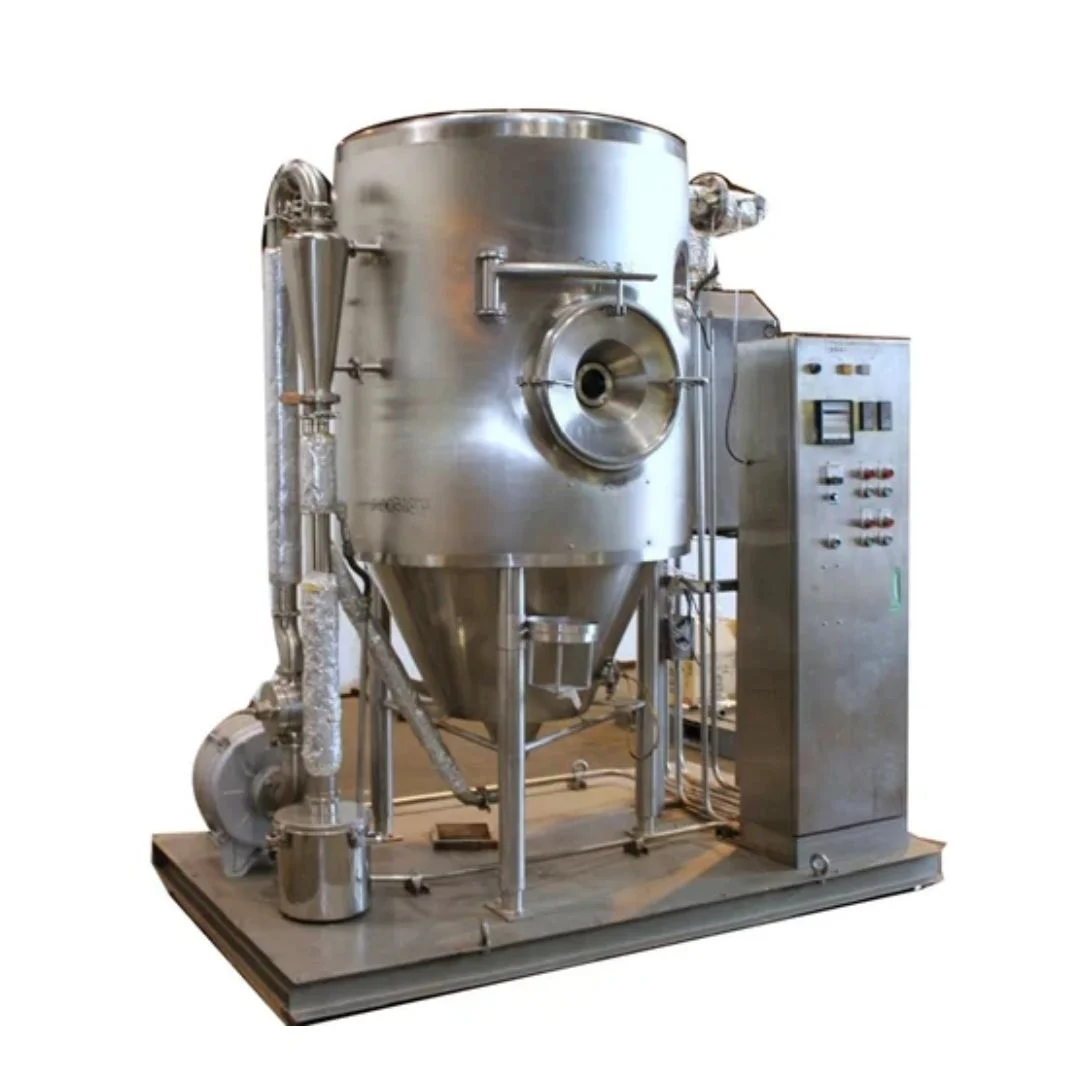
Atomization: A high-speed rotary disk or pressure nozzle breaks the liquid feed into a fine mist of droplets.
Spray-Air Contact: The droplets meet a stream of hot air (or nitrogen for flammable solvents) inside the main drying chamber.
Rapid Evaporation: Moisture flashes off the surface of each droplet almost instantaneously—usually within 2 to 3 seconds.
Powder Separation: The dried particles drop out of the air stream and are collected via cyclones, bag filters, or wet scrubbers.
Main Types of Spray Dryers
- Rotary Disc Dryers: Use centrifugal force to spin liquid into droplets; best for high-volume slurries, dyes, and ceramics.
- Nozzle Dryers: Use pressure or two-fluid designs; ideal for heat-sensitive items and controlled particle sizes.
- Multistage Dryers: Combine a primary spray chamber with integrated fluid beds; great for sticky, instant, or dairy powders.
- Closed-Cycle Dryers: Recycle the drying gas instead of venting it; built for organic solvents or sterile pharmaceutical runs.
Key Industrial Applications
- Food & Dairy: Milk powder, whey protein, instant coffee, and flavor microencapsulation.
- Pharmaceuticals: Inhalable dry powders, heat-stable vaccine particles, and drug carriers.
- Chemicals & Detergents: Wash powders, ceramic pigments, catalysts, and polymer resins.
Advantages vs. Limitations
- Why choose it: Delivers fast, single-step production with strict control over bulk density, moisture, and particle size. It also outperforms slower methods like drum or freeze drying on sheer throughput.
- What to watch out for: Equipment footprints are bulky, initial capital costs are high, and thermal efficiency can drop if exhaust heat isn’t recovered.
Leave a Reply